
From the Great Lakes to the Coast: Meet Our Freshwater Conservation Partners
Posted by Bill Davis on Aug 24th 2026
Earlier this month we introduced you to the nine beachgoods.com giving partners working on ocean conservation. Now, as we approach World Lake Day on August 27, we're following the water inland: to the lakes, ponds, rivers, streams and then estuaries where much of it starts before it reaches the coast / ocean.
beachgoods.com is a certified 1% for the Planet member, and freshwater conservation gets just as much of that commitment as ocean work does. Here's where that support goes, traced the way water actually moves: lake to river to coast.
- beachgoods.com's 1% for the Planet commitment funds freshwater conservation nonprofits working on lakes, rivers, and estuaries, not just ocean-focused ones.
- USGS data finds Great Lakes surface waters average 112,000 microplastic particles per square mile.
- American Rivers named the Potomac River the most endangered river in the U.S. for 2026, citing data-center expansion and pollution.
- The Clean Water Fund 18 oz Tempercraft bottle is made from rescued factory misprints, and 75% of its proceeds go directly to Clean Water Fund initiatives.
- See the full list of who beachgoods.com supports at Our Commitment.
Where Freshwater Starts: The Great Lakes
The Great Lakes hold about one-fifth of the world's surface freshwater, which makes the Alliance for the Great Lakes' job enormous by definition. The organization runs Adopt-a-Beach, a volunteer cleanup and monitoring program that's been collecting shoreline litter data since 1991, longer than any other citizen-science dataset on this list. A 2024 analysis of that 20-plus years of data found that 86% of the litter collected on Great Lakes beaches is partially or fully plastic, and 40% of it is small enough to classify as "tiny trash," under an inch across. That kind of long-running, hands-on dataset is exactly why the Alliance is one of our partners.
Where Freshwater Moves: America's Rivers
Once water leaves a lake, American Rivers is often the organization watching what happens to it next. Each year, the group publishes America's Most Endangered Rivers, a report now in its 41st year that carries real weight with lawmakers. The 2026 edition named the Potomac River the most endangered river in the country, driven by data-center expansion and pollution, with PFAS contamination on the Lumber River and mining threats to the Boundary Waters, Rogue, and Chilkat rivers also flagged. It's advocacy at a national scale, spanning dozens of river systems rather than one region.
Inland Ocean Coalition
Not everyone who cares about ocean health lives anywhere near a coast, and that's exactly the gap the Inland Ocean Coalition exists to close. Based in landlocked Boulder, Colorado, the organization runs a free, five-week Inland Ocean Ambassador training program twice a year. It's trained over 250 Ambassadors from 38 U.S. states and 38 countries so far, people who go on to run cleanups, join call-in campaigns, and make the case that what happens hundreds of miles from an ocean still ends up in it eventually.
Where Rivers Meet the Sea: Estuaries
Estuaries are the last stop before fresh water becomes ocean water, and they're disappearing fast. Restore America's Estuaries reports that U.S. coastal wetlands have lost over half their historical extent in the last 200 years. The organization's current focus treats that loss as a climate issue as much as a habitat one: its Blue Carbon Action Plan pushes the carbon-storage value of salt marshes, mangroves, and seagrass into federal climate policy, and it runs cleanup and restoration grants, typically $1,000 to $4,000, through its Caring for Our Coast program. In September 2026, it's hosting the Coastal & Estuarine Summit in San Francisco, one of the field's biggest annual gatherings.
Our Own Small Piece of This
Four organizations, four different points along the same path water takes from a lake to the ocean. Here's the smallest piece we add to that path ourselves.
Our Clean Water Fund 18 oz Black Tempercraft Water Bottle isn't a specially manufactured "eco" product. It started as a factory misprint, the kind of item that would normally get thrown out over a labeling error, then got rescued and rebranded instead of discarded. Seventy-five percent of what you pay for one goes directly to Clean Water Fund initiatives. It's vacuum-insulated stainless steel, keeps drinks cold up to 24 hours, and comes with a sports lid. A small, practical way to put money toward clean water every time you fill it up.
Clean Water Fund 18 oz Black Tempercraft Water Bottle, $19.95
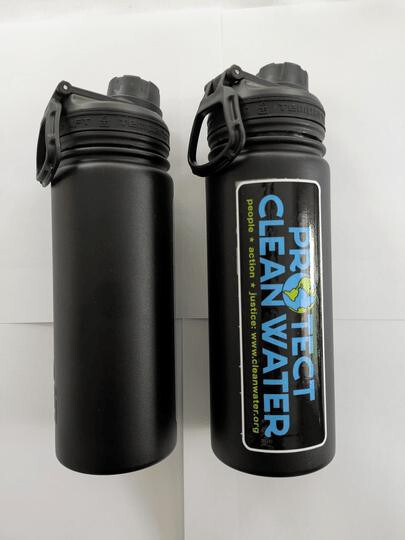
18 oz vacuum-insulated stainless steel bottle that keeps drinks cold up to 24 hours and hot 6+ hours. BPA-free, fits most standard cup holders, and includes a sports lid for easy drinking. These are factory misprints rescued from disposal and rebranded with Protect Clean Water stickers. 75% of proceeds go directly to Clean Water Fund initiatives.
Why we carry this: Every fill-up puts money toward the same kind of freshwater work covered above. It's the easiest way to make your everyday hydration part of the mission, and it started life as a factory reject instead of new material.
The Bottom Line
Water doesn't recognize the line where a lake ends and a river begins, or where a river ends and the ocean begins. Neither does our 1% for the Planet commitment. These four partners, plus the nine we introduced earlier this month, cover the whole path: from the Great Lakes down to the reefs.
Read the ocean half of this story: Ocean Conservation, Education & Science Nonprofits: Meet the Partners We Support.
Every beachgoods.com purchase supports our 1% for the Planet commitment.
See Who We Support → | Shop beachgoods.com