
Reef-Safe Sunscreen Explained: Mineral vs. Chemical + Ingredients to Avoid
Posted by Bill Davis on Jun 25th 2026
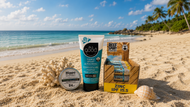
"Reef safe" is printed on thousands of sunscreen bottles. The FDA has never defined the term. Any brand can use it on any product, with no regulatory standard required and no ingredient requirement attached.
That's not a minor footnote. NOAA confirmed in April 2025 that 83.7% of the world's coral reef area has been hit by bleaching-level heat stress since January 2023, the fourth global bleaching event on record. Sunscreen is one of the few human-controlled stressors we can actually do something about. But only if we know what we're buying.
This guide covers what "reef safe" actually means (and why the label alone tells you nothing), which ingredients cause reef damage, what non-nano zinc oxide is and why the particle size distinction matters, and how to check a sunscreen label so you can shop with confidence.
|
Key Takeaways · "Reef safe" is an unregulated marketing claim. Any brand can use it. Hawaii and Maui County are the closest thing to a legal standard, banning specific ingredients, not the label itself. · The FDA classifies only two UV filters as safe and effective: zinc oxide and titanium dioxide. All 12 chemical UV filters remain under active FDA review with no approval. · Non-nano zinc oxide (particles larger than 100nm) stays on the skin surface. Nano particles penetrate coral tissue. The label must say "non-nano" for the distinction to hold. · Only 22.6% of the 2,204 sunscreens tested in EWG's 2025 Annual Guide met safety criteria (EWG, May 2025). · Every sunscreen in our reef-safe collection uses non-nano zinc oxide or non-nano titanium dioxide as its active UV filter. |
What Does "Reef Safe" Actually Mean?
The term "reef safe" has no legal definition in the United States. The FDA hasn't defined it, and no federal regulation restricts which products can use it. A brand can print it on a formula containing oxybenzone, the ingredient most linked to coral bleaching, and face no legal consequence.
The closest thing to a U.S. legal standard comes from two pieces of state and county legislation. Hawaii became the first state to ban the sale of sunscreens containing oxybenzone or octinoxate effective January 1, 2021, under Hawaii Revised Statutes Section 342D-21. Maui County passed Bill 135 in October 2022 to ban all non-mineral sunscreens countywide, the strictest local restriction in the country.

The coral reef ecosystems that reef-safe sunscreen is intended to protect.
Those bans define what to avoid, not what qualifies as reef safe. A genuinely reef-safe sunscreen uses a mineral UV filter, zinc oxide or titanium dioxide, in non-nano particle size. That's the ingredient-based definition worth shopping by. The rest of this guide will explain why.
A useful habit: skip the front-of-pack claims entirely. Flip the tube over and look at the active ingredients. That's where the actual formula lives.
|
"A truly reef-friendly sunscreen contains only two possible active ingredients — non-nano zinc oxide and/or non-nano titanium dioxide. That's it. If anything else is listed as an active ingredient — oxybenzone, octinoxate, octocrylene, avobenzone, homosalate — it's not reef friendly, no matter what the label claims." |
How Chemical Sunscreen Ingredients Damage Coral Reefs
Research published in the Archives of Environmental Contamination and Toxicology found that oxybenzone is toxic to juvenile coral at a concentration of 62 parts per trillion, the equivalent of a single drop dissolved in an Olympic-size swimming pool (Downs et al., 2016, cited by NOAA). Between 4,000 and 6,000 tons of sunscreen wash off swimmers into the world's oceans each year, according to the U.S. National Park Service.
Oxybenzone doesn't only affect reefs. CDC data cited by the Surfrider Foundation's 2026 Reef Friendly Sunscreen Guide found the compound in the urine of more than 90% of the 2,500-plus people tested, confirming it absorbs through human skin and enters the bloodstream. It's both a reef problem and a human health question.
|
"Petrochemical sunscreens can seriously damage and even kill corals, and exacerbate coral bleaching by weakening them. One drop of oxybenzone can contaminate 6.5 Olympic-sized swimming pools." |
The mechanism runs through several pathways. Oxybenzone acts as an endocrine disruptor in coral larvae, interfering with normal development. It triggers viral infections in coral tissue and accelerates bleaching even at concentrations well below the direct toxicity threshold. Octinoxate, the second most commonly banned ingredient, has similar bleaching effects on coral polyps.
NOAA confirmed in April 2025 that 83.7% of the world's coral reef area has been impacted by bleaching-level heat stress across at least 83 countries, the fourth global bleaching event on record. Sunscreen is one factor among several. It's one of the few factors entirely within consumer control.
Mineral vs. Chemical Sunscreen: What's the Difference?
The FDA classifies only two UV filters as Generally Recognized as Safe and Effective (GRASE): zinc oxide and titanium dioxide, at concentrations up to 25%. All 12 chemical UV filters currently used in U.S. sunscreens, including oxybenzone, octinoxate, and octocrylene, remain under active FDA review. None have received a GRASE designation (FDA, 2021, ongoing).
The difference in how they work is meaningful. Chemical filters absorb UV radiation and convert it to heat inside the formula. Mineral filters, specifically non-nano zinc oxide and non-nano titanium dioxide, sit on the surface of the skin and physically scatter and deflect UV rays. They don't absorb into skin, don't enter the bloodstream, and don't penetrate coral tissue. Chemical filters do all three.
A common concern about mineral sunscreen is that it doesn't protect as well. Research published by the University of New South Wales in December 2025 found the UV protection difference between mineral and chemical sunscreens is smaller than commonly reported. Mineral SPF 50+ provides comparable broad-spectrum (UVA and UVB) protection at the concentrations used in modern formulas. This objection is largely outdated.
The industry has already started responding. EWG found oxybenzone in only 9% of non-mineral sunscreens in their 2025 Annual Sunscreen Guide, down from roughly 70% in the mid-2010s. State bans, consumer pressure, and ongoing FDA review are all driving reformulation. That progress is meaningful, but 9% isn't zero.
The Full Ingredients to Avoid List
Only 498 of 2,204 sunscreens (22.6%) analyzed in EWG's 19th Annual Guide to Sunscreens met criteria for adequate UV protection without worrisome ingredients (EWG, May 2025). The other 77.4% failed. Oxybenzone and octinoxate get most of the attention because Hawaii banned them. The full list of ingredients linked to reef damage is longer.
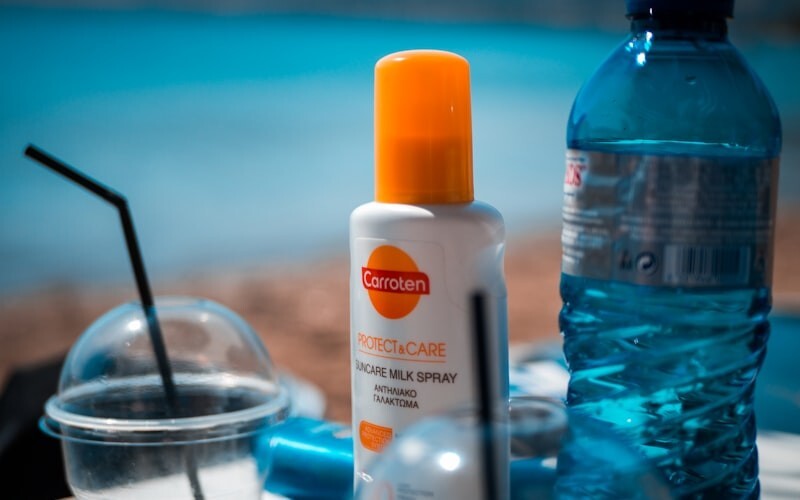
Always check the active and inactive ingredient list, not just the front-panel claim.
|
Ingredient |
Regulatory Status |
Why It's a Problem |
|
Oxybenzone |
Banned in Hawaii and Maui County (2021, 2022) |
Toxic to juvenile coral at 62 ppt; found in over 90% of human urine samples tested (CDC) |
|
Octinoxate |
Banned in Hawaii and Maui County (2021, 2022) |
Coral bleaching and marine ecosystem disruption |
|
Octocrylene |
Flagged by EWG and Surfrider Foundation |
Degrades to benzophenone; toxic to aquatic organisms |
|
Homosalate |
Under FDA review |
Potential hormone disruption; aquatic toxicity flagged |
|
PABA |
Largely phased out in the U.S. |
Coral toxicity; high rate of skin sensitization |
|
Parabens |
Flagged by Surfrider Foundation |
Endocrine disruption in marine organisms |
|
Triclosan |
Flagged by Surfrider Foundation |
Aquatic organism toxicity; antibiotic resistance concerns |
|
Nano zinc oxide / nano TiO2 |
No ban, but flagged |
Particles under 100nm may penetrate coral tissue |
That last row matters more than most guides acknowledge. Zinc oxide is used in both nano and non-nano particle sizes. Nano particles are smaller than 100 nanometers. At that size, they can be absorbed into coral tissue. Non-nano particles, above 100nm, stay on the skin surface. They don't penetrate coral tissue.
A sunscreen listing "zinc oxide" as its active ingredient isn't automatically safe for reefs. It depends on the particle size. The label needs to say "non-nano zinc oxide" specifically. If it just says "zinc oxide" and doesn't specify particle size, you can't verify it from the label alone.
What to Look For Instead: Non-Nano Zinc Oxide Explained
Non-nano zinc oxide (particles larger than 100nm) is the gold standard for genuinely reef-safe UV protection. It's the only UV filter that is FDA-approved as GRASE, provides broad-spectrum coverage for both UVA and UVB rays, and sits on the skin surface without entering coral tissue.
When we source sunscreens for Beach Goods, non-nano zinc oxide is the first thing we verify with every supplier. The All Good Sport formulas in our suncare collection confirm "non-nanoparticle zinc oxide" directly on the label. The Hippo Sweat formula uses both non-nano zinc oxide and non-nano titanium dioxide. We checked the ingredient lists before we listed any of them.
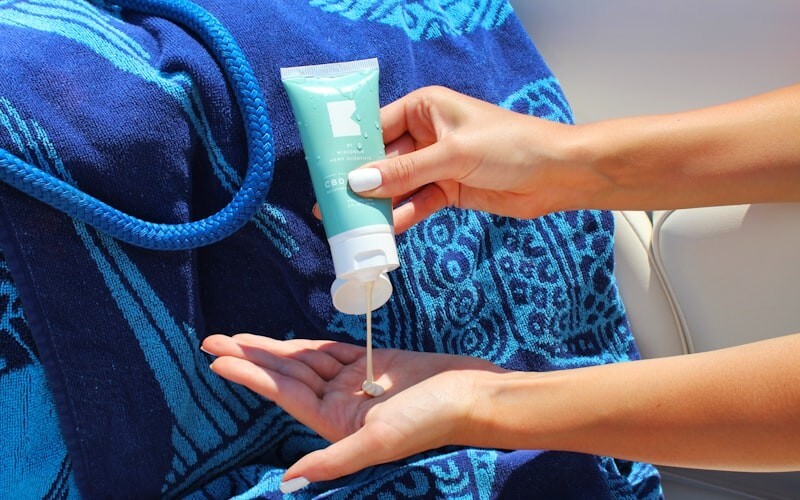
Checking the label before you buy is the only reliable way to verify a reef-safe claim.
One practical point that most reef-safe guides skip: reapplication timing for swimmers. Even water-resistant mineral sunscreen washes off. The water-resistance rating on the label (40 minutes or 80 minutes) is the maximum time in the water before protection fades significantly. Reapply immediately after toweling off, not at the 40- or 80-minute mark. By then, you've usually been in and out of the water more than once.
How to Shop for Reef-Safe Sunscreen
EWG's 2025 Annual Guide found that 77.4% of the 2,204 SPF products tested failed their safety criteria. Most store shelves are still stocked with formulas that fall short. Here's what to check before you buy.
Three things to look for on the label:
- Active ingredient: Must say "non-nano zinc oxide" or "non-nano titanium dioxide." Plain "zinc oxide" without the non-nano designation doesn't confirm particle size.
- Inactive ingredients: Scan for oxybenzone, octinoxate, octocrylene, and homosalate. If any appear, set it back on the shelf.
- SPF 30 or higher: For full-day beach use. SPF 15 is adequate for brief incidental sun, not for hours on the water.
Two more things worth knowing:
"Broad-spectrum" on the label is an FDA-mandated claim. A sunscreen can only use that phrase if it provides both UVA and UVB protection. Non-broad-spectrum products only protect against UVB rays, missing the longer UVA wavelengths that cause deeper tissue damage.
The water-resistance rating (40 min vs. 80 min) describes how long the formula holds in water before needing reapplication. For surfing, snorkeling, or open-ocean swimming, choose an 80-minute formula.
|
Mineral sunscreens from our reef-safe collection — broad-spectrum and in stock. |
Our Reef-Safe Picks
|
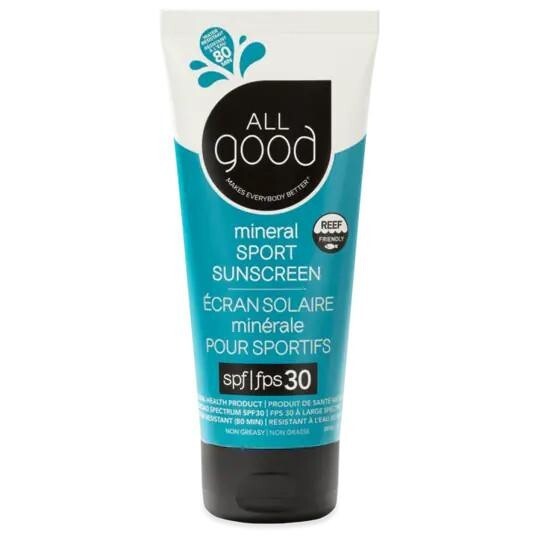
All Good Sport Mineral Sunscreen Lotion SPF 30 — $17.95
Non-nanoparticle zinc oxide at 16%, confirmed on the label. Broad-spectrum UVA/UVB. Water-resistant up to 80 minutes. Lightweight and non-greasy, hypoallergenic, free of gluten, GMOs, parabens, and chemical UV filters. 3 oz tube. Why we carry this: The most versatile daily-use option in our suncare lineup. High enough SPF for full beach days, thin enough formula to wear on the face without residue. |
|
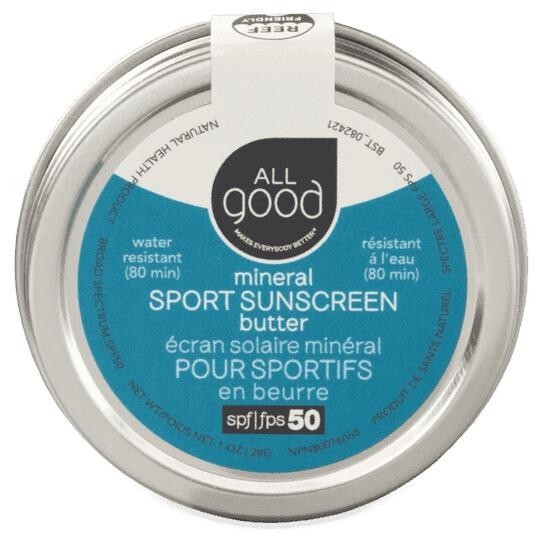
All Good Sport Mineral Sunscreen Butter SPF 50 — $9.95
Non-nanoparticle zinc oxide. Rich, thick consistency designed for active use in and out of the water. Organic ingredients, no synthetic preservatives, no parabens. SPF 50 blocks approximately 98% of UVB rays. 1 oz tin. Why we carry this: For surfers, snorkelers, and anyone spending extended time in direct sun. The higher SPF and heavier formula hold up through repeated water exposure. |
|
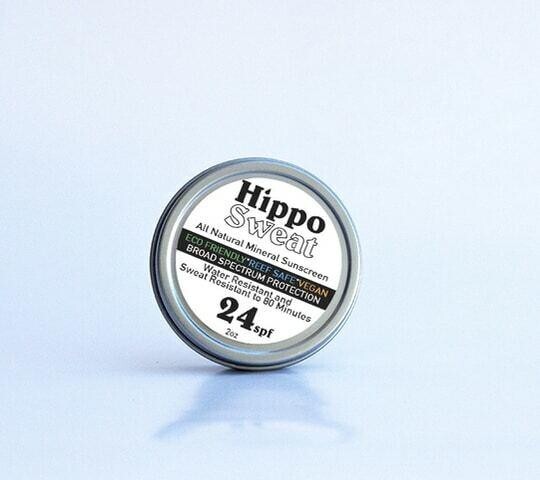
Hippo Sweat All Natural Mineral Sunscreen SPF 24 — $10.95
Non-nanoparticle zinc oxide and non-nanoparticle titanium dioxide. Made with candelilla wax, jojoba, shea butter, red raspberry oil, and sesame seed oil. No synthetic chemicals. SPF 24 blocks approximately 95% of UVB rays. 2 oz tin. Currently on sale from $12.00. Why we carry this: The cleanest formula in our collection. A strong pick for anyone with sensitive skin or a preference for short, natural ingredient lists. |
Also in Our Suncare Collection
|
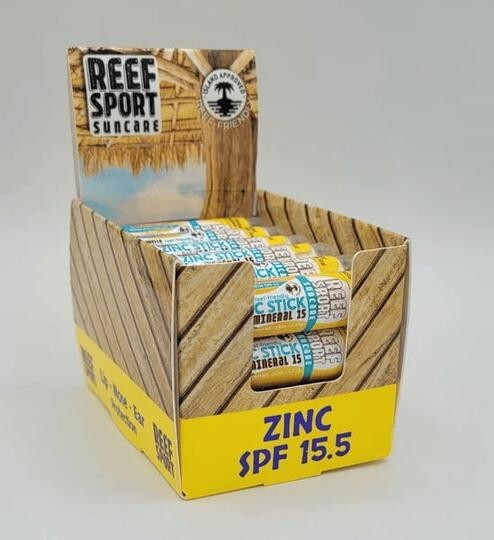
Reef Sport Zinc Stick SPF 15.5 — $2.95
Zinc oxide with organic fair-trade coconut oil and cocoa butter. Designed for targeted application on the nose, ears, cheekbones, and lips. Vanilla and coconut scent. 0.15 oz stick. Why we carry this: The nose and ears burn fast and get missed by lotion application. This stick covers those spots without waste or mess. Best used alongside an SPF 30+ lotion for full-body coverage. |
Frequently Asked Questions
Is reef-safe sunscreen regulated by the FDA?
No. The term "reef safe" is not defined or regulated by the FDA or any U.S. federal agency. Any brand can use it without meeting specific ingredient requirements. Hawaii banned oxybenzone and octinoxate in 2021 under Hawaii Revised Statutes Section 342D-21, and Maui County extended that to all non-mineral sunscreens in 2022. Those are the closest legal standards in the U.S. For all other products, go by the active ingredient list, not the label claim.
Does mineral sunscreen protect as well as chemical sunscreen?
Yes, at equivalent SPF ratings. A study from the University of New South Wales published in December 2025 found the protection difference between mineral and chemical sunscreens is smaller than commonly reported. Non-nano zinc oxide at SPF 50+ provides comparable broad-spectrum UVA and UVB protection. The main practical differences are texture (mineral formulas tend to be thicker) and application feel, not protection level.
What is non-nano zinc oxide and why does it matter?
Non-nano zinc oxide means zinc oxide particles larger than 100 nanometers. At that size, the particles stay on the skin surface and can't be absorbed into coral tissue. Nano particles, smaller than 100nm, can penetrate coral tissue and cause harm. A sunscreen can list "zinc oxide" as its active ingredient and still contain nano particles. The label specifically needs to say "non-nano zinc oxide" for you to verify it from packaging alone.
How often should I reapply mineral sunscreen when swimming?
Reapply immediately after toweling off, and every 40 to 80 minutes of water time depending on the water-resistance rating on the label. Don't wait until the rated time is up. Ocean swimming, surfing, and physical activity accelerate wash-off. The 40-minute and 80-minute ratings describe maximum water time under lab conditions, not real-world beach activity.
Is oxybenzone still in most sunscreens?
Less than before. EWG found oxybenzone in only 9% of non-mineral sunscreens tested in their 2025 Annual Sunscreen Guide, down from roughly 70% at its peak. The shift is driven by Hawaii's 2021 ban, consumer pressure, and ongoing FDA review. That said, 9% isn't zero. It still appears in products on store shelves. Always check the active and inactive ingredient list before buying.
The Bottom Line
Reef safety starts with the ingredient label, not the front-panel claim. Non-nano zinc oxide and non-nano titanium dioxide are the only UV filters the FDA has approved as safe and effective. They're also the only filters confirmed to stay on the skin surface without penetrating coral tissue. Every other UV filter in common use is either banned in Hawaii or still under active FDA review.
NOAA confirmed in April 2025 that 83.7% of the world's coral reef area has been hit by the fourth global bleaching event on record. That's a big number with a lot of causes. Switching to a genuinely mineral sunscreen won't fix it alone. But it removes one entirely controllable stressor from the equation, every time you pack for the beach.
- Look for "non-nano zinc oxide" or "non-nano titanium dioxide" as the active ingredient.
- Check inactive ingredients for oxybenzone, octinoxate, octocrylene, and homosalate.
- Reapply after every water session, not just every 80 minutes.
For more on ocean health and our commitment to reef-safe sourcing, check back for our World Ocean Day guide this June. In the meantime, you can browse all confirmed mineral formulas in our reef-safe sunscreen collection.