
World Water Day
Posted by Eugene Lefter on Mar 22nd 2026
World Water Day: Why Sustainability Starts Upstream ?
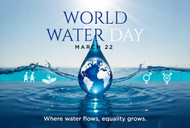
World Water Day, observed each year on March 22, was established by the United Nations to draw attention to freshwater access, management, and protection (source). More than a symbolic date, it reflects a growing reality: water is one of the most constrained and consequential resources shaping environmental, economic, and social outcomes.
Sustainability conversations often focus on carbon because emissions are easier to measure and compare. Water, by contrast, is local, unevenly distributed, and deeply tied to geography. But in practice, water availability and quality often determine whether systems, ecological or economic, can function at all.
Water is not a background resource ?
Freshwater systems sit at the center of nearly every supply chain. Rivers, lakes, wetlands, and groundwater feed agriculture, manufacturing, energy production, and urban growth. When these systems are stressed through overuse, contamination, or climate volatility, the impacts cascade downstream.
For coastal environments in particular, what happens upstream matters. Nutrient runoff, industrial discharge, and altered river flows directly affect estuaries, fisheries, and nearshore ecosystems. Ocean health does not begin at the shoreline. It begins far inland.
Scarcity is no longer theoretical ⚠️
Water stress is no longer limited to traditionally arid regions. Climate change is intensifying extremes, longer droughts in some areas, heavier flooding in others, making water availability less predictable and more contested. These shifts affect food security, infrastructure planning, insurance risk, and regional stability.
As a result, water risk is increasingly treated as a material concern by businesses and policymakers, not just environmental advocates. Access to reliable, clean water has become a prerequisite for resilience.
The hidden water footprint ?
Water is embedded in everyday products and systems, often invisibly. Agriculture accounts for the majority of global freshwater use. Textile production relies heavily on irrigation, processing, and dyeing. Even materials positioned as low carbon or “green” can carry significant water impacts depending on sourcing and manufacturing practices.
This is why lifecycle thinking matters. Environmental impact is not limited to what we see or use directly. It is shaped by extraction, processing, transport, and end of life outcomes, many of which depend on water.
Access and equity ?
World Water Day also highlights a persistent global imbalance: billions of people still lack reliable access to safe drinking water and sanitation. Water insecurity disproportionately affects communities already exposed to economic and climate risk, amplifying inequality and limiting opportunity.
Addressing water challenges therefore requires more than efficiency improvements. It demands long term stewardship, infrastructure investment, and governance that treats water as a shared resource rather than an unlimited input.
Why this lens matters
World Water Day is not about celebration. It is a reminder to look beyond surface level metrics and consider the systems that support everyday life. Sustainability efforts tend to be most effective when they account for constraints, not just innovation, and when they prioritize durability, protection, and responsible use over short term optimization.
Following the water often reveals where those constraints really are.